Profile
Old Town’s quiet habit: a Daughter of St. Paul keeps the door open
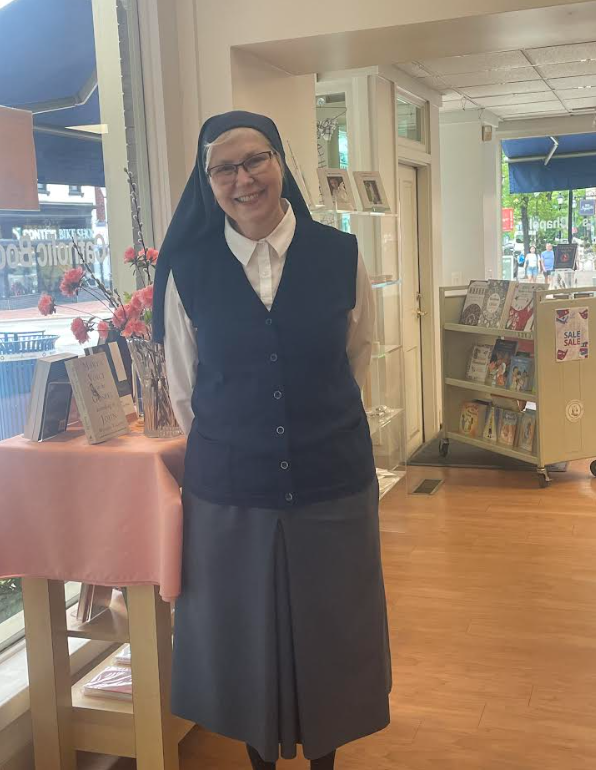
ALEXANDRIA, Va. — The bell above the door at Pauline Books and Media rings and Sister Julia Mary Darrenkamp looks up from behind the counter. Twelve saint medals jingle on a single jump ring at her chest, Mary Magdalene at the center.
“She’s like my saint,” Sister Julia says.
She is a Daughter of St. Paul, one of over 44,000 religious nuns in America today, which is down from its peak of 181,421 in 1965, according to the Center for Applied Research in the Apostolate at Georgetown University. Her order was founded in 1915 in Alba, Italy, by Blessed James Alberione and Mother Thecla Merlo around a single concept: evangelization through media. Alberione envisioned the bookshops his sisters would open as “centers of service … light and warmth.” More than a century later, Sister Julia keeps one of them in Old Town, where the work is mostly being available.
Sister Julia did not grow up Catholic.
The story she tells starts when she was 13, in 1969, in Lancaster County, Pennsylvania, known as Amish country and Protestant through-and-through. She and her best friend Christine had been reading books about Catholic saints. The books sent them church-hopping. Lutheran. Methodist. One day they walked into a church called the Sacred Heart of Jesus Catholic Church.
“I said, wow, there’s so many things to see,” Sister Julia recalls. “But this is what made the connection. The books that we were reading about, this church had stained glass windows of them.”
The two girls went looking for more saint books and found their way to a Daughters of St. Paul bookstore in Philadelphia. The nuns behind the counter looked at them with their stack of books and asked a question that would change Julia’s life.
Did you ever think of becoming a sister?
“I haven’t given it much thought,” Julia answered. “But I’m pretty sure you have to be Catholic for that.”
She wasn’t yet. Her family, in her words, “very Protestant roots, very fervent Protestants,” considered her interest in Catholicism totally foreign. The standoff between them broke unexpectedly. Julia’s mother went home to visit her own mother — a woman who had raised seven children with no religion — to complain about her daughter’s Catholic ambitions.
“Well, Joyce, I don’t see what the problem is,” the grandmother said. “I’m Catholic.”
Six months earlier, the grandmother had taken a job as a cleaning lady at a parish and quietly converted, telling no one. She invited her granddaughter to come to Mass with her, and the standoff ended. Julia joined the Catholic Church in January 1972.
When she finally asked her parents if she could become Catholic, her father’s response was, “No, because the next thing I know is you’re going to tell me you want to become a nun.”
As a teen, Julia was, by her own account, a romantic. Around the time of her conversion, the Franco Zeffirelli film “Brother Sun, Sister Moon,” a retelling of the lives of St. Francis and St. Clare, came out in theaters. Julia saw it. She left the theater and announced to a friend that she wanted to give away everything she owned and become a Poor Clare nun. Her friend, Julia recalls, declined to join her. For years she wrote letters to Mother Mary Francis at the Poor Clare monastery in Roswell, New Mexico.
Her Protestant parents would only let her travel to the Daughters of St. Paul.
“I think that was God’s direction too,” she says. “He used my romantic heart.”
More than five decades later, she is still behind a counter, but this time asking strangers the version of the question once asked of her.
The Daughters of St. Paul opened the King Street store in 1982. It occupies a sunlit storefront at 1025 King Street, on the corner of Henry. Upstairs they keep a small chapel available to anyone who wants to escape Old Town’s bustle and pray during business hours. The sisters live there too.
Sister Julia is on her fourth tour of duty here. She was first stationed in Alexandria in 1985, returned in 1989, and again in the 1990s. In between, she spent fourteen years in New Orleans and a stint in Charleston. She is now in her third year of the current posting.
“Sometimes people aren’t necessarily looking for the product,” she says. “They’re looking for the relationship. Sometimes they just want to come in and talk to the sisters.”
She begins each morning at the Basilica of Saint Mary, the historic parish a few blocks east. During Mass, she has a habit of praying the same thing: “You can send all the searchers to me. I’m ready.”
Sister Julia keeps an Instagram account at @srjulia, where she posts saint art and book recommendations to roughly 82,600 followers — a digital extension of an order that has been thinking about media as ministry for over a hundred years. She sees the present moment clearly.
“There’s so many people that convert or come back to the church, and then it’s like they’re on their own,” she says. “Where do they go for that information?” She would like a “convert club,” somewhere people who are curious can ask the questions that don’t fit into formal instruction.
“How do you pray? Do you have a prayer corner? What do you put in it? Where do you start?”
For now, that place is the bookshop on King Street.
Reported, written and photographed by Mary Sandrick for Georgetown University’s journalism program, 2026.